


Towering trees, knobby cypress knees, and a forest shaped by centuries of flooding make Congaree National Park one of South Carolina’s most fascinating natural treasures. Just 30 minutes from Columbia, the park protects the largest remaining tract of old-growth bottomland hardwood forest in the United States. It’s also home to some of the tallest trees in eastern North America.
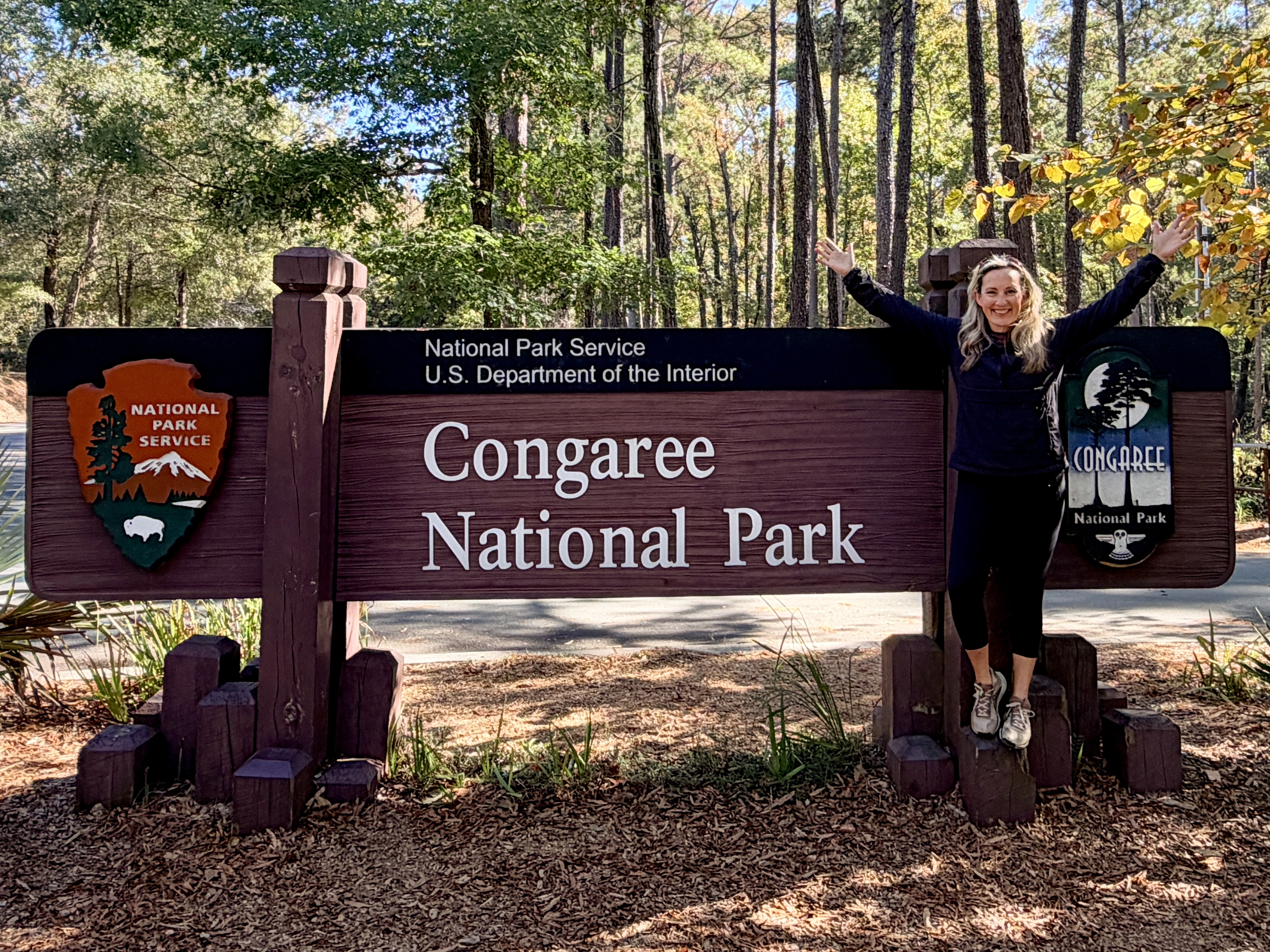
On a beautiful late October morning, my friend Adeina and I explored Congaree National Park on its 2.6-mile Boardwalk Loop Trail. I had visited this national park in my home state years ago so it was nice to return with a friend on her first visit. Fall is a wonderful time to visit, with cooler temperatures, and fewer mosquitoes than during the hot, humid summer.
Walking Congaree’s Boardwalk Loop Trail
The easy, mostly elevated trail starts at the Harry Hampton Visitor Center. Pick up the self-guided trail brochure before heading out. The boardwalk is a lollipop loop. When you reach the loop, go right to follow the numbered interpretive stops in order.
One of the first fascinating stops is the dark, muddy forest floor. Called Dorovan muck, this mixture of clay and decomposing leaves can be eight feet thick. It’s nature’s water filter, trapping pollutants and helping keep the floodplain’s water clean.
At stop 3, the majestic bald cypress trees steal the show. Their unusual “knees” rise from the roots. Their purpose isn’t fully understand, but one theory is they help stabilize trees during floods and high winds.
Bald cypress trees can live for 1,000 years. Their rot-resistant wood earned the nickname “wood eternal.” Native American tribes, including the Catawba and Congaree, used it for canoes. Extensive logging in the late 1800s left few old-growth bald cypress trees standing.


Fascinating Finds Along the Boardwalk
At stop 5, the landscape changes as dense stands of switch cane, resembling bamboo, cover the forest floor. This thick growth is called a canebrake. Here, the boardwalk’s guardrails disappear, making it feel as though you’re walking right through the forest.
Other interesting stops include standing dead trees called snags and low channels known as guts and sloughs. These channels help distribute water throughout the forest when the Congaree River floods.
At stop 10, a fallen loblolly pine tells another story. The tree may have lived for 200 years before Hurricane Hugo toppled it in 1989. Loblolly pines are among South Carolina’s tallest trees and tolerate wetter conditions than many other pine species.


Don’t skip the short detour at stop 12 for a lovely view of Weston Lake. This oxbow lake was once a bend in the Congaree River. More than 2,000 years ago, the river gradually shifted south, leaving the lake behind.
The final stops include a lightning-struck tree, dwarf palmettos, and remnants of a moonshine still used during Prohibition.
At stop 16, Hurricane Hugo’s impact is still visible. Tornadoes associated with the 1989 storm toppled large trees, opening the forest canopy and allowing sunlight to reach new seedlings and vines. As a meteorologist, I especially enjoyed seeing how a powerful storm continues to shape the forest decades later.


How Much Time Do You Need at Congaree National Park?
Congaree may not have dramatic mountain vistas, but there’s something special about walking among ancient trees in a forest that has survived centuries of floods, storms, and human history. It’s an easy national park to explore in a morning and a worthwhile stop on a South Carolina road trip.
We leisurely completed the 2.6-mile Boardwalk Loop in about an hour and 25 minutes, including stops to read the interpretive signs, take pictures, and admire the towering trees.
I’d recommend allowing 90 minutes to two hours to really enjoy the loop.
For a different perspective, consider paddling Cedar Creek. We looked into a three-hour, four-mile guided canoe tour with Palmetto Outdoor. The tour is $100 per person departing from South Cedar Canoe Landing near Gadsden. You need to book in advance.
We opted for the boardwalk, leaving us more time to continue our South Carolina adventure. Congaree National Park is very close to Lake Marion, one of South Carolina’s Great Lakes. For a post park lunch, head to the tiny town of Eloree to kick-off exploring the lake fun nearby Santee Cooper Country.
